
Smart Wearables, Smart Security: Cybersecurity Guide for Smart Wearables
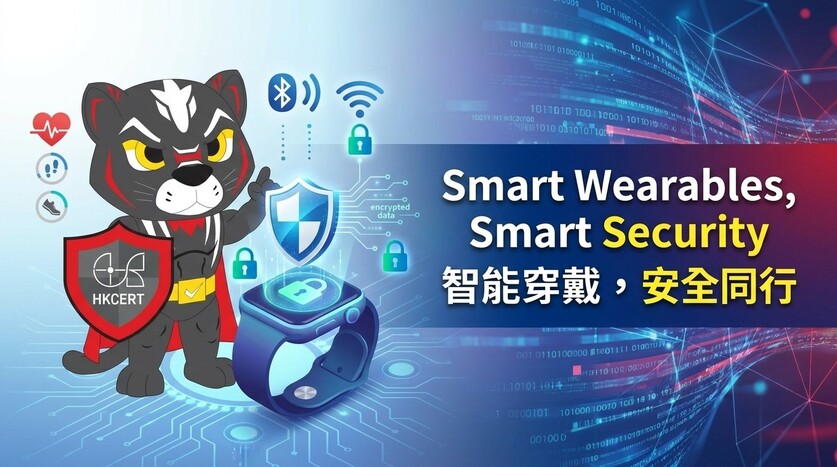
(Image generated by generative AI and reviewed under professional human supervision.)
As smart technologies become increasingly integrated into daily life, smart wearable devices have gradually become part of citizens’ daily lives in recent years. In general, smart wearable devices refer to electronic devices that can be worn on the body and use sensors, software, and wireless connectivity to collect, process, or transmit data. Common examples include smartwatches, fitness trackers, smart rings, smart glasses and similar devices. By contrast, ordinary watches, regular glasses, jewellery without sensors or connectivity, and wearable items used only for display or decoration that cannot collect or synchronise personal data are generally not considered smart wearable devices. Smart wearable devices can not only record data such as steps, heart rate, sleep quality and exercise routes, but they can also receive mobile phone messages, support electronic payments and even connect to smart home devices, bringing considerable convenience to daily life.
But at the same time, smart wearable devices may continuously collect and process a large amount of personal data. Such data is not limited to steps or calories, but may also include sensitive data such as health records, location information, message notifications and account information. A survey shows that 90% of smart wearable devices monitor at least one type of health or lifestyle data, 63% record location data, 23% of smart wearable brands explicitly share or sell personal data to third-party advertisers, and 55% share de-identified biometric data with external research institutions. If such data is improperly accessed, excessively shared or leaked, it may infringe personal privacy and even pose risks to users’ personal safety.
As smart wearable devices become increasingly popular, biometric data, health data and location information are being continuously collected at an unprecedented scale. This blog introduces four common types of security risks associated with smart wearable devices and provides simple and practical protection advice to help citizens improve cybersecurity and privacy protection in daily use.
Please refer to the following video for a quick overview of the key points: https://youtu.be/T5OhL8xvfGw
1. Transmission Vulnerabilities
Smart wearable devices are generally connected to mobile phones via Bluetooth or Wi-Fi, involving operations such as device pairing and data or notification synchronisation. If the connection process does not adopt sufficient security encryption, or still uses outdated communication protocols, attackers may have the opportunity to intercept wireless signals and thereby access sensitive data.
According to related research on IEEE Xplore, Bluetooth, as a commonly used communication protocol for smart wearable devices, may face multiple security risks, including eavesdropping, Man-in-the-Middle attacks, device impersonation and unauthorised access. As smartwatches, smart earbuds and other devices commonly rely on Bluetooth to pair with mobile phones and synchronise data, the security of wireless pairing and data transmission processes has become an important area of concern. Earlier this year, the KU Leuven COSIC research team disclosed a vulnerability named WhisperPair, which found that some Bluetooth accessories supporting Google Fast Pair had security weaknesses in the implementation of their pairing process, attackers can exploit the vulnerabilities to hijack devices, access microphones and even track users’ locations without users’ knowledge. Although WhisperPair does not target all smart wearable devices, the case also shows that if wireless connections and pairing processes lack sufficient security protection, they may bring privacy and data security risks to users.
Protection Advice:
- Avoid accepting pairing requests from unknown or suspicious devices.
- Pair devices only in trusted environments, and avoid performing first-time pairing in public places or unfamiliar network environments.
- After pairing is completed, turn off the “discoverable by other devices” or “public pairing” function.
- Regularly check the list of paired devices and remove devices that are unknown or no longer used in the Bluetooth settings of the mobile phone.
- When viewing, uploading or synchronising sensitive data on smart wearable devices, connect to trusted networks where possible and avoid using unknown or unencrypted free Wi-Fi networks.
- Regularly update smart wearable devices and related mobile applications to patch known vulnerabilities.
2. Data Privacy and Security Risks
Smart wearable devices collect different types of personal data, If such data is not adequately protected during storage, synchronisation or sharing, it may increase the risk of unauthorised access, data leakage or misuse, further exposing sensitive information such as users’ lifestyle habits, health conditions, daily whereabouts and even home addresses.
NBC News once reported that Swedish security personnel shared running and cycling routes on fitness applications, causing information such as private holiday locations of royal family members and the locations, overseas visit itineraries and private addresses of a number of important persons to be leaked. The incident shows that security risks do not necessarily arise from systems being hacked. Sometimes, merely oversharing exercise records or failing to adjust privacy settings may be enough to expose personal whereabouts and lifestyle patterns, increasing privacy and personal safety risks.
In addition, many smart wearable devices are connected to mobile applications, cloud services, health platforms, exercise communities or third-party applications. If these platforms, applications or accounts lack sufficient security protection, while users authorise excessive data synchronisation or continue to keep unused third-party connections, sensitive data may be processed, stored or accessed by more platforms or services, increasing the risk of unauthorised access, data leakage or misuse.
Protection Advice:
- Regularly check the permissions of applications related to smart wearable devices, including location, contacts, photo albums, notifications and health data, to ensure that only genuinely necessary permissions are granted.
- Handle location data with caution. If recording running routes or real-time location is not needed, turn off continuous location tracking or change it to “allow only while using the application”.
- Adjust the privacy settings of exercise records to avoid publicly displaying frequently used routes, locations near home, or places frequently visited.
- Before sharing a workout route, consider whether it might reveal sensitive information, such as your home or work address.Synchronise data to the cloud or third-party platforms with caution. Before enabling integrations with health platforms, exercise communities or third-party applications, understand what data will be shared, with whom it will be shared and for what purposes. It is recommended to grant only necessary permissions, and to regularly check and disable data synchronisation or sharing functions that are no longer needed.
- If reselling or disposing of a smart wearable device, first unlink it from the mobile phone and cloud account, and perform a factory reset.
3. Device System Flaws
A smart wearable device itself is also a small computer, containing an operating system, firmware, applications, communication modules and so on. Like mobile phones and computers, these systems may also contain security vulnerabilities. Once a vulnerability is exploited by attackers, it may lead to device data being accessed, functions being disrupted, or even the device being controlled.
System defects in smart wearable devices are not merely theoretical risks. OpenCVE data shows that Multiple Common Vulnerabilities and Exposures (CVE) have been identified in smart watch–related products, involving risks such as improper access control, Bluetooth pairing handling, cloud permissions, screenshot functions and sensitive data access. In addition, a vulnerability (CVE‑2025‑12080) has also been disclosed in a smartwatch operating system. When the device’s default messaging application contains flaws in handling message‑sending requests, attackers may be able to send messages on behalf of the user without requiring additional permissions or user confirmation. Such vulnerabilities may even be exploited to distribute phishing messages or impersonate users for fraudulent activities. The above cases remind users that when purchasing smart wearable devices, they should not only focus on functions and price, but should also pay attention to whether the brand provides regular security updates, whether it has a clear privacy policy, and whether users are allowed to disable unnecessary functions.
Protection Advice:
- If the device and mobile application support automatic updates, enable the automatic update function.
- Regularly enter the device settings or mobile application to confirm whether it has been updated to the latest version.
- Download applications only from official channels, and avoid installing smart wearable management tools, unofficial synchronisation tools or third-party applications from unknown sources.
- Avoid using devices that are no longer supported. If a device has not received security updates for many years, or the brand has stopped support, consider discontinuing use or replacing it to reduce the risk of known vulnerabilities being exploited.
- Enable device lock functions, such as a Personal Identification Number (PIN), pattern lock, or functions linked to the mobile phone’s unlocked status.
- If the brand or mobile phone system supports finding the device, remote locking or remote data erasure functions, it is recommended to complete the relevant settings in advance.
4. Weak Login Protection
Many smart wearable devices need to be used together with mobile applications and cloud accounts. Users can view health reports, exercise records, sleep data, device settings and historical data through the relevant accounts. Therefore, the security of smart wearable devices does not depend only on the device itself, but is also closely related to account login protection.
If an account password is too simple, or the same password is reused across multiple platforms, it may provide attackers with an easier entry point. When a data leak occurs on one platform, attackers may use the same account password to attempt to log in to other platforms. For smart wearable users, this may give attackers the opportunity to access health records, exercise data, location and other information. Even email, social platforms, exercise communities or cloud synchronisation services connected to the account may also be affected. Stolen data may be further used for phishing messages, account takeover, identity theft or other fraudulent activities.
Protection Advice:
- Use strong passwords, and avoid using birthdays, phone numbers, names or simple consecutive numbers. It is recommended to use longer passwords that combine uppercase and lowercase letters, numbers and symbols.
- Avoid reusing passwords. Different platforms and different accounts should use different passwords.
- If the platform supports it, enable multi-factor authentication. Even if the password is leaked, attackers still need to pass additional verification before they can log in to the account.
- Regularly check login records and the list of logged-in devices. If unknown logins, unfamiliar devices or abnormal account activities are found, change the password immediately and log out of all devices.
- Beware of phishing links. When receiving SMS messages or emails claiming to be from smart wearable brands, health platforms or cloud services, do not click on links. Log in to the account through the official application or official website.
Smart wearable devices bring convenience to daily life, but at the same time involve multiple security aspects, including wireless transmission, data collection, system updates and account login. Transmission vulnerabilities may allow data to be intercepted during pairing or synchronisation. Insufficient data security may expose sensitive data. Device system flaws may be exploited by attackers, while weak login protection may lead to account takeover. While enjoying the convenience of smart wearables, citizens should maintain good security habits, including secure pairing, limiting permissions, sharing location cautiously, regularly updating systems, using strong passwords and enabling multi-factor authentication, so as to better protect personal data and reduce related security risks.
Reference Links:
Share with